
Customized Overhead Gantry Crane
Customized Overhead Gantry Crane with Hooks is a strong and adaptable lifting solution designed to satisfy the demanding needs of a variety of industrial applications. This Overhead Gantry Crane is suitable for heavy-duty lifting because to its superior strength, stability, and precision. It is designed for reliable and effective material handling in shipyards, warehouses, building sites, and manufacturing plants.
After much design and optimization based on previous experience, our engineers are now highly mature in customizing and process manufacturing. Nucleon crane is a robust and dependable lifting solution that combines strength, adaptability, and precision. Its sturdy structure, adaptable design, and innovative functionality make it an indispensable tool for businesses that require heavy-duty material handling. Whether at a factory or shipping yard, this crane provides maximum performance, safety, and efficiency.
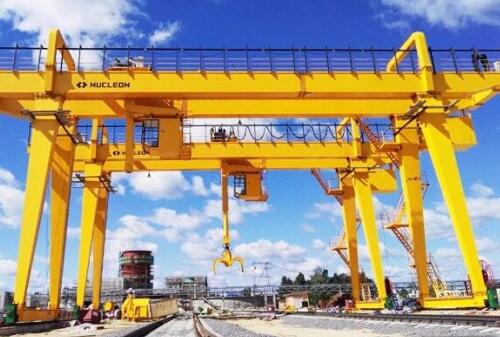
Customized Overhead Gantry Crane Structure
Main Girders: The double girder design consists of two parallel horizontal beams, typically made from steel. These girders are the primary load-bearing elements of the crane, providing the strength and stability required to lift and transport heavy loads. The girders are connected by a cross beam, which enhances the overall structural integrity.
Legs (Supports): The girders are supported by two or more vertical legs that extend down to the ground. These legs are usually equipped with wheels, allowing the crane to move along a predefined path. The legs provide the necessary height for the crane to clear obstacles and handle materials at various levels.
End Carriages
Wheels and Rail System: The end carriages are the sections at the ends of the girders that house the wheels and drive mechanisms. These wheels run on rails or tracks, allowing the crane to move back and forth along its designated path. The wheels can be rubber-tired for outdoor or non-rail applications, or steel for running on rail tracks.
Drive Mechanism: The movement of the crane is powered by motors located in the end carriages. These motors drive the wheels and enable the crane to travel along its path, providing the horizontal motion needed to position the crane over the load.
Hoist and Trolley
Hoist: The hoist is the lifting mechanism that raises and lowers the load. In a double girder gantry crane, the hoist is typically mounted on a trolley that moves along the length of the girders. The hoist consists of a motor, drum, and wire rope or chain. The motor powers the drum, which winds the rope or chain to lift or lower the load.
Trolley: The trolley travels horizontally along the main girders, carrying the hoist and the load it is lifting. The trolley is equipped with wheels that run on rails mounted on the
girders. The movement of the trolley allows the crane to position the hoist directly above the load, providing precise control over the lifting operation.
Control System
Operator Cabin: In larger gantry cranes, an operator cabin may be provided. This cabin is typically mounted on one of the girders or on a separate structure attached to the crane. From the cabin, the operator can control all aspects of the crane’s operation, including movement, lifting, and safety systems.
Remote Control: Many modern double girder gantry cranes are equipped with wireless remote controls, allowing the operator to control the crane from a distance. This enhances safety and flexibility, as the operator
can move to a safe vantage point while controlling the crane.
Automation and PLCs: Some cranes are equipped with programmable logic controllers (PLCs) and automated systems that can perform predefined lifting and positioning tasks with minimal human intervention. These systems improve efficiency and reduce the potential for human error.